Shifts in Animation Pipelines That Influence Visual Cohesion Across Multi-Platform Reel Entertainment Systems
Yves Neumann · Aug 26, 2026
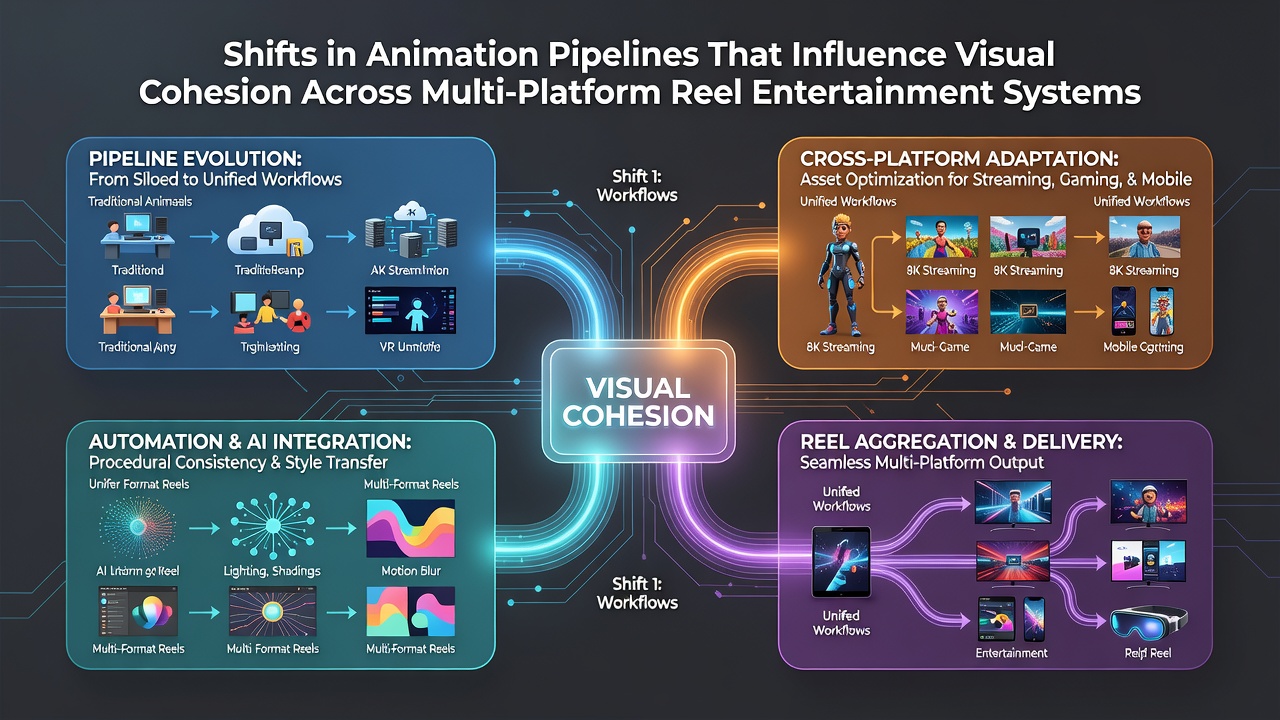
Shifts in Animation Pipelines That Influence Visual Cohesion Across Multi-Platform Reel Entertainment Systems
Animation pipelines in reel entertainment systems have undergone substantial transformations in recent years as developers integrate advanced rendering technologies and asset management protocols to maintain visual consistency across smartphones, tablets, desktops, and emerging console platforms. These changes address the technical demands of real-time synchronization while preserving frame rates and graphical fidelity regardless of hardware variations.
Core Components of Modern Animation Pipelines
Traditional sequential workflows have given way to modular systems that allow simultaneous asset creation, testing, and deployment. Studios now employ cloud-based rendering farms combined with procedural generation tools, which enable teams to adjust lighting, particle effects, and reel spin mechanics in a single environment before pushing updates to multiple platforms at once. Data from industry tracking services indicates that adoption rates for these integrated pipelines rose notably between 2024 and 2026, particularly among providers targeting international markets with diverse device ecosystems.
Engine upgrades play a central role here. Many operations have transitioned from legacy custom engines to hybrid frameworks that incorporate elements from Unity and Unreal Engine derivatives, while retaining proprietary reel-specific modules for symbol animation and payout sequence handling. This hybrid approach reduces redundancy in asset conversion steps and minimizes discrepancies in how symbols scale or transition during bonus rounds when accessed via different screen sizes.
Impact on Visual Cohesion Across Devices
Visual cohesion requires that color grading, motion blur, and particle density remain uniform whether content renders on a high-refresh-rate monitor or a mid-range mobile display. Pipeline shifts facilitate this through automated calibration scripts that detect device capabilities at runtime and adjust shader parameters accordingly. Observers note that such automation has decreased reported instances of visual artifacts, such as jagged edges on animated reels or inconsistent lighting in thematic backgrounds, according to aggregated user feedback compiled by platform analytics firms.

Cross-platform testing protocols have also evolved. Automated regression suites now simulate thousands of device configurations in parallel, flagging deviations in animation timing before release. Those who manage large-scale deployments report that these protocols have shortened iteration cycles, allowing updates to reach markets faster while upholding standardized visual output. In August 2026 several major titles incorporated these refined testing layers during their scheduled platform rollouts, resulting in measurable alignment of frame pacing across iOS, Android, and web-based clients.
Technical Shifts Driving Pipeline Evolution
Real-time collaboration tools integrated into animation software enable artists located in different regions to work on the same reel sequence simultaneously, with version control systems tracking every modification to maintain asset integrity. This distributed model supports the inclusion of region-specific visual tweaks without fracturing the core animation library. Research conducted by academic groups focused on digital media production shows that such collaborative pipelines correlate with higher consistency scores in multi-territory releases.
Artificial intelligence assists in texture upscaling and motion interpolation, tasks that previously required manual intervention across separate builds for each platform. These AI components operate within the pipeline to generate device-optimized variants from a master asset set, thereby reducing human error in alignment of visual elements. Figures released by European regulatory bodies overseeing digital entertainment content confirm that providers utilizing AI-augmented pipelines have achieved tighter control over graphical output standards.
Industry Examples and Implementation Patterns
One documented case involves a collaboration between a boutique developer and an established studio that leveraged shared animation repositories to launch a seasonal theme across mobile and desktop formats in synchronized waves. The approach relied on parameterized animation curves that scaled automatically, preserving the intended timing and visual weight of reel movements irrespective of hardware constraints. Similar patterns appear in releases scheduled throughout 2026, where pipeline standardization has become a prerequisite for securing distribution agreements with multi-platform aggregators.
Another instance centers on the integration of blockchain-verified asset checksums into the pipeline itself. This addition ensures that any downstream modification to animation files triggers alerts, safeguarding cohesion when content distributes through third-party operators. Reports from Australian industry associations highlight how these verification layers have supported compliance efforts in markets with stringent content consistency requirements.
Conclusion
Pipeline advancements continue to reshape how reel entertainment systems deliver uniform visual experiences across fragmented device landscapes. By centralizing asset control, incorporating automated calibration, and embedding verification mechanisms, developers establish frameworks that sustain cohesion even as hardware diversity expands. Ongoing refinements through 2026 demonstrate measurable progress in reducing platform-specific variances while supporting efficient content updates for global audiences.